Its All in the Details

And the Word became flesh and lived among us, and we have seen his glory, the glory as of a father’s only son, full of grace and truth. (John 1:14)

This one verse from the opening passage from the gospel of John is very familiar to many Christians. The prologue to John’s gospel is poetic, and artistic in its articulation of the the concept of a preexistent Word that co creates with God. It has a beauty all its own as it conveys the nature, character, and power of the preexistent Word. Those opening 13 verses establishes the preeminence of the Word of God and its all encompassing scope in the plan of God for creation. 

But the above verse, in particular, provides an important and cosmic insight…

And the Word became flesh…

The Word- cosmic in scope, eternal in being, and spiritual in nature- became flesh. This one sentence summarizes the idea of incarnation. Said differently, the whole of Christian revelation about God and Jesus Christ is summarized in these words. The implication is that the cosmic and universal God decided to be particular and specific. God chose in Jesus, to be enfleshed, incarnated, and particularized. 

Most Christians rightly assert that this singular act of God conveys a lot about God. Eternality choosing mortality begs a lot of questions that most of the discipline of theology seeks to address. While I am not rehashing theological questions here, I simply offer the following observation: The Word became a specific flesh. 

Enfleshment isn’t a generic concept. Skin wraps bodies. Human bodies are physical with shapes, colors, and contexts. They interact with other bodies. Those bodies also have shapes, colors, and contexts. Bodies inhabit communities, systems and structures in order to establish societies, powers, and ways of being in the world. When God chooses flesh, God chose all that came with it- the particularities, the specifics and the uniqueness therein. 

In other words….

God, in the incarnation, is concerned about the particular- always has been. God chooses a particular body to be incarnated through. God does this, in part, to value that body (and others like it) in the face of all that bodies like his would experience. God in Jesus, comes to know what it means to be brown, oppressed, and overlooked in life. Eternity understands finality and limitation firsthand.

God gets involved in the details…
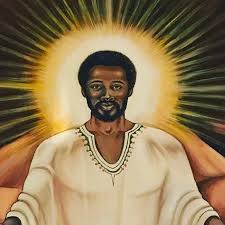
Black Jesus? Or just another Particularity?

 I am continually puzzled at the way many Christians view the Black Lives Matter conversation and movement. Many churches have refused to embrace the particularity of focusing on Black lives, because “God cares and loves everybody” or “theologically speaking, all lives matter to God”. And while I understand the meaning behind those sentiments, they reality of scripture does not make those sentiments true in and of themselves. IN fact, I can say that those statements about God are true just as much as scripture does not affirm that message. Scripture actually conveys a God who very often puts the lives of certain people over others. A quick set of questions:

Did Egyptian Lives Matter during the Exodus?

Did Canaanite Lives Matter during much of the conquests in Joshua?

Did Goliath’s life matter in front of David’s army?

Did the Syrophoenician woman’s life matter when she asked Jesus for assistance?

If you are honest in reading your Bible you will realize the answers are not what an “all lives matter to God” crowd would want them to be. The revelation of scripture conveys a God is always particular. So particular that God chooses a particular body to engage humanity. 

And yet, God, as revealed in Jesus, provides for a more expansive view of God’s own love and what lives matter to God. In some respects it is the founding mission and legacy of the Christian church that shows us who matters. Paul and the great commission charges the followers to make sure that all lives matter- “in Judea, Samaria, and the uttermost parts of the world”. 

Black Lives Matter offers both an assertion about the particularity of human life and a prayer on seeing and affirming that life. God is always particular about human life. Being able to recognize that God’s particularity is not about favoritism, but about dignity is the vision of truth. Just remember, its all in the details…  

Comments Off on Its All in the Details

Filed under Uncategorized

Quick Talk

Reflecting on the last six weeks of great conversations!

Comments Off on Quick Talk

Filed under Uncategorized

They Are All Watching

Therefore, since we are surrounded by so great a cloud of witnesses, let us also lay aside every weight and the sin that clings so closely, and let us run with perseverance the race that is set before us, (Hebrews 12:1)

Memorial to those who were kidnapped into slavery. National Memorial for Peace and Justice (picture taken by me)

The importance of community is central in many cultures around the world, but especially in the distinct cultures of West Africa. Whether Yoruba, Fon, Bassa, or Krue, the distinct cultural orientation is toward a communal sense of self-definition. Cultures built on communal understandings are often self propagating- their character and identity grow as the community grows. 

Key to this propagation are the elders. The founders, elders, and ancestors are the keepers of the culture. Inheritors of meaning, and transmitters of history, elders serve to maintain the character of the community and define the parameters of our shared life together. The elders, the fore-parents, and the ancestors watch, tell, speak, poke, prod, nudge, and urge us into the fullness of ourselves. This is as true for those who walk alongside us as those who’ve walked before us.

Could it be that the writer of Hebrews had this understanding in mind when they penned this twelfth chapter? 

After spending most of the previous chapter talking about the heroes of ancient Israel, the writer transitions his argument by using two interrelated metaphors. The first metaphor conjures the communal ancestors as a “great cloud of witnesses” who are looking on and encouraging us from eternity. They encourage us- here is the second metaphor– to “run the race set before us”, as if discipleship is a race that we must continue to run.

The beauty of this passage is just how obvious and straightforward the metaphors fit and apply. They stand the test of time. And, they make good African (and African American) sense.  Many of us in the African American experience have heeded and appreciated the words of our foremothers and forefathers. The value of their wisdom, experience, and guidance shaped our communal values and defined our first understandings of the world around us. The passage here celebrates this important lynchpin in our faith- our heritage and history.

The fact that our elders hopes and dreams are invested in our successes is just as true in the spiritual sense as they are in the secular sense. Every word of encouragement spoken by an elder and every prayer prayed by our ancestors is realized a bit more fully in us. No wonder they look on and speak to us, sing to us, walk with us, and nourish us. Our success is their success.

We have so much work to do. So much to work on in our society, our culture, and our faith. This is a work of perfecting, correcting, and rewriting. A work of tearing down in order to build up and restore. And this work is not new…

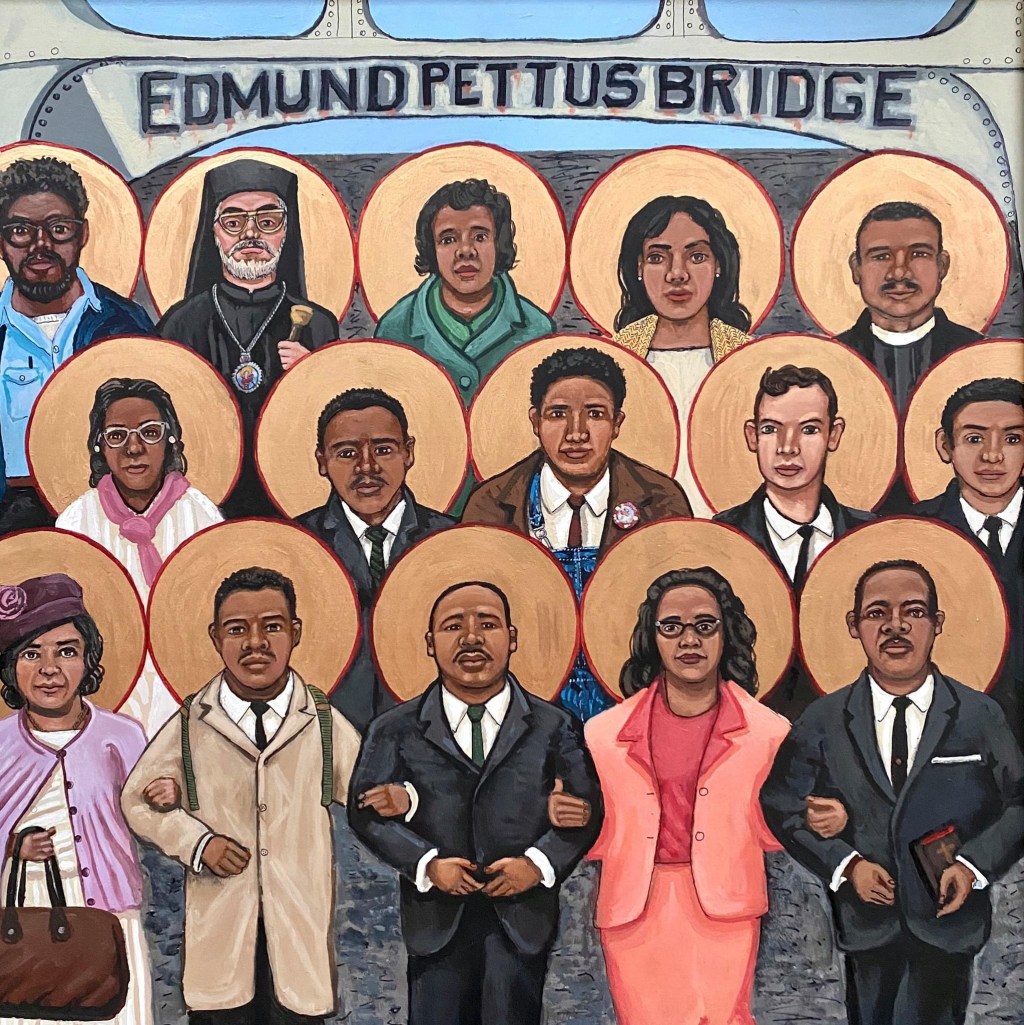
It began with a great cloud of witnesses. Witnesses who saw destruction, kidnapping, and loss.

Artwork from artist Kelly Lattimore- http://kellylatimoreicons.com/

Ancestors who were freedom loving but were denied freedom. 

Elders who walked tall in spite of being beat down.

Foreparents who were denied promises so that we could be promising. 

Each generation encouraging the next with hopes, dreams, songs, and prayers. Believing that their living would not be in vain.

Isn’t good to know that they are the ones looking on and encouraging us, even now, 

“to bring good news to the oppressed,

to bind up the brokenhearted,

to proclaim liberty to the captives,

and release to the prisoners;

to proclaim the year of the Lord’s favor,

and the day of vengeance of our God;

to comfort all who mourn;

to provide for those who mourn in Zion—

to give them a garland instead of ashes?”

Can’t you see them? Aren’t they a vision for us to keep on running toward? Keep the faith, and the fight.

Asé

Comments Off on They Are All Watching

Filed under Uncategorized

Conversations the Matter: Rereading Our Faith

Comments Off on Conversations the Matter: Rereading Our Faith

Filed under Uncategorized

“Got to Give it Up…”

Jesus said to him, “If you wish to be perfect, go, sell your possessions, and give the money to the poor, and you will have treasure in heaven; then come, follow me.” When the young man heard this word, he went away grieving, for he had many possessions (Matt 19:21-22)

Lyrics from Marvin Gaye’s “Got to Give it Up”

The story of the rich young ruler brings into sharp contrast, the existential questions of being a disciple of Jesus. This familiar passage deeply cuts any of us who are privileged to live as this young man who encounters Jesus. 

He comes to Jesus seeking the answer to eternal life. Although we are not told at the outset, he comes as wealthy young man with “many possessions”. His wealth notwithstanding, his most outstanding feature is hubris. He boldly comes to Jesus with a question that would otherwise be considered brash or presumptuous. The question itself overlooks the important rituals, practices, and behaviors for blessing in this life. It is indicative of the man himself.

Jesus’ initial response to his question attempts to steer the young man to the important work still to be performed in this life saying, “You shall not murder; You shall not commit adultery; You shall not steal; You shall not bear false witness; Honor your father and mother; also, You shall love your neighbor as yourself.” These are the commandments that emphasize the social contract, the aspects of the faith that keep us in good relations with one another. In a way, Jesus  undermines the young man’s question about eternal life, by pointing him to relationships in this life. 

Message received?

No!?

In an act that further demonstrates his self-righteousness, the young man tells Jesus, “I’ve done all that”. In other words, “I have checked that box and am in good relations with my neighbors”. To which Jesus delivers the real call of faith and neighborly relations,

“If you wish to be perfect, go, sell your possessions, and give the money to the poor, and you will have treasure in heaven; then come, follow me”

This is it. This is the place where faith and allegiance really matter. Jesus lays down a marker of authentic faith and believe. If you really seek the perfection that you say you believe in, give away that which you have lived to acquire and follow me. 

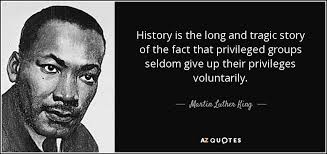
from https://www.azquotes.com/quote/769300

The conditions Jesus set forth to the young man are still true today. For there are many of us who espouse strong belief in heaven, eternal life, and the ways that scriptures point to happiness. But we so readily neglect the neighborly aspects of our faith that we forget the power of our faith to change the world not just by the miracle of the heart, but by a helping hand. 

And when we are faced with the measure of our faith being summed up by Jesus’ condition to give away what we have and follow him, we don’t measure up. We are little better than this young man, who, chooses not to receive the very thing he says he wanted, just because it cost him too much: the very things he actually believed in. 

Beloved, this is what it means to be in solidarity with Jesus, to be willing to give away all that you believe in, just to follow him. 

To follow him requires us to measure what we believe in and what we say we believe. 

Following him means foregoing the privilege of this life for the promise of something better. 

For some of us, even that invitation is still too much to bear. Yet, I envision a truth in which we all discover that what we possess does not signify what we believe. 

Thanks be to God.

Comments Off on “Got to Give it Up…”

Filed under Uncategorized

Conversations that Matter Episode 5

Comments Off on Conversations that Matter Episode 5

Filed under Uncategorized

Too Busy Working, Ain’t Got Time…

At that very hour some Pharisees came and said to him, “Get away from here, for Herod wants to kill you.” He said to them, “Go and tell that fox for me, ‘Listen, I am casting out demons and performing cures today and tomorrow, and on the third day I finish my work. (Luke 13:31-32)

Boy hard at work…

This passage in the Gospel of Luke embodies Jesus’ approach to ministry. Here, at this point in the gospel, Jesus is making his way to Jerusalem. He has taught and fed thousands. He has liberated bound souls on the way to the seat of the oppressive political and religious system. 

At that moment (“at that hour”), some come to tell him to leave this place in order to protect his life. “Herod wants to kill you”, they say. Jesus sends Herod a response through them, “I am casting out demons and performing cures today and tomorrow, and on the third day I finish my work.” His message is clearly a rebuke of them and of Herod. It is also a subversive message that undercuts the power of Herod and the Pharisees who deliver it. 

Its both a message of confrontation and an embodied message of resistance. Jesus is conveying his own power to control his message and his identity. First the confrontation…

Jesus calls Herod a “fox”, (more accurately, a dog), and indicates that he is here to do his “work”. Jesus will not be deterred or intimidated by fear of reprisal or retribution. He confronts Herod and the messengers with a a commitment to continue “the work”. 

Secondly, Jesus resists co-opting and complacency in the face of options to do something else. When the messengers come, he could have demurred, delayed, or deferred his efforts. Jesus could have also attacked them and told them that they are upholding the power system and doing Herod’s work for them. Instead, he states quite plainly, “I am casting out demons and performing cures today and tomorrow, and on the third day I finish my work.”  Its almost like he says, “I ain’t got time for this!” 

Jesus’ confrontation and resistance are hallmarks to his ministry. Whether addressing earthly systems or demonic powers, Jesus confronts them directly while resisting all attempts to define him or his work. At each and every step, the work he performs “casting out demons, performing cures” and liberating the last and the forgotten is designed not for his personal gain or following, but for the ushering in of a greater kingdom. The work Jesus does is not for himself, but for others.

These insights are good for us today as well for Jesus’ work is our work…

Protestors and Counter Protestors in Charlottesville August 2017.

We are equally called to the task of confrontation and resistance. Although we get the confused sometimes, Jesus’ confrontation is about facing that which comes before you. Resistance is about not letting that which confronts you define you. Said differently, confrontation does not always mean resistance, but every act of resistance requires confrontation. 

For us, the liberative work of Jesus requires us to confront the Herod’s of our day- sometimes calling them our of their name. Calling them what they are…

This work means confronting powers, systems, and people directly. It means protesting as we have come to understand it. 

Jesus’ work also means resisting. And resisting is harder because it requires fortitude and self definition. In order to resist, you have to know yourself and know why your resist. 

You have to know your movement and what you are fighting for. 

It means knowing enough about your fight to not settle when tokens or symbols are placed before you (or streets are renamed or statues crumble). 

It means foregoing confrontation in the streets because you are resisting in boardrooms and council chambers and classrooms. 

When we work in this way, for the sake of the demon possessed, the sick, and the captive, we are just beginning the work that Jesus was modeling. Seeing the work in this light allows us to glance a vision of truth. 

Comments Off on Too Busy Working, Ain’t Got Time…

Filed under Uncategorized

Conversation that Matters Episode 4

Comments Off on Conversation that Matters Episode 4

Filed under Uncategorized

Overcoming the Pilate Problem

So when Pilate saw that he could do nothing, but rather that a riot was beginning, he took some water and washed his hands before the crowd, saying, “I am innocent of this man’s blood; see to it yourselves.”(Matthew 27:24)

Hand washing…

Pontius Pilate, was the Roman governor of Judea from approximately 26-36 CE; roughly the time of Jesus life and ministry. Pilate, by most accounts was a Roman knight who, through obedience and faithfulness to the emperor, sought higher status in the Roman empire. He worked up through the ranks from courtesan to prefect in the “troubled” prefecture of Judea. His place in history was cemented in that he presided over the trial and crucifixion of Jesus.

While Pilate is one of the few verifiable (by Western standards) historical figures in the New Testament, his last years after the pivotal Good Friday “incident” remain a mystery. However, his behavior in the trial provides a very important point of reflection for us to consider. 

As we read all of the Gospel writers, we hear that Pontius Pilate is generally a good man, one who follows the law and seeks the peace. After all, you cannot advance in the imperial ranks if you preside over dysfunction. The text is clear, when Jesus is brought to him, Pilate examines him and “finds no fault with this man”. He attempts to do what he can under Roman law to set the man, Jesus, free. And it is that action that creates the problem. For the text tells us that when Pilate pushes against the crowds wishes, that’s when he has to face their anger. 

Pilate crumbles in the face of the aggression of the crowd. At the moment of greatest need for leadership; for the rule of law, and the establishment of reason for the innocent, Pilate “washes his hands”. 

This is what I call, “the Pilate Syndrome” or “the Pilate Problem”.

This is a problem and malady that has faced many people throughout history. Its a curious condition that strikes well meaning, good spirited, law abiding, and even bible thumping people. It strikes usually at the moment of greatest need and in the most specific of circumstances. Usually when there is a distinctly moral dilemma facing the individual or the leader, the Pilate Problem sways them to ignore the decision of greatest moral clarity and instead capitulate to the position of neutrality and contrived ignorance.  

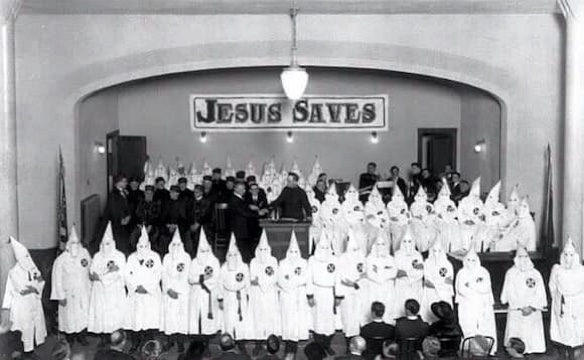
KKK meeting from the 1920s (location unknown)

For America, white supremacy and its lattice work of socio-political support are the moral decision of our day. Throughout the 244 year history of the republic and the near 400 year history of Black people on the continent, the racial construction of whiteness and Blackness have been the moral dilemma of every major historical figure in power. From Thomas Jefferson’s Notes on the State of Virginia, to Lincoln’s Second Inaugural Address, to President Wilson’s resegregation of federal offices to the current president’s speech on Charlottesville, leadership in America (primarily of white persons), have exhibited all the symptoms of the Pilate Problem.

(You know, I could make a case about how this malady may inflict those who also look like Pilate, but perhaps that is just mere coincidence.)

Whether it is “hand washing” or #whitesilence, the problem is still the same. There comes a time when those in positions of authority, are called to address the moment, to speak to the crowds and lead. Pilate refused to lead for fear of his future governmental appointment. Leaders in white institutions, structures and organization have also refused to lead for similar reasons. 

Perhaps the Good News is simply this: the key to overcoming the Pilate Problem is not just in Pilate’s hands (clean though they may be). Its in Jesus’s witness. For you see what makes Pilate a historical figure and one who becomes the exemplar of inaction and impotence, is the clear eyed, stiff backed, brown man with curly hair named Jesus. The innocent man condemns the governor to the historical books as a coward who is afraid of the governed and afraid to stand up for justice. Jesus’ witness reveals the cowardice of Pilate’s position.

In our current day, it is the ongoing witness of hundreds of thousands of stiff backed, clear-eyed multicolored protestors across the country, standing up to America’s historical pathology of the Pilate Syndrome that has finally caused movement. Shame is part of the regimen for treating the Pilate Syndrome. Companies, governments, and even “Karens” all over the country are shamed into doing what is right. And while this isn’t the ideal, it is the start of the hard cure.

The only panacea for this condition is bravery in the midst of befuddlement; morality in the midst of malaise, and leading when you are all alone in the crowd. The more that we all speak through our witness, the more the we can see the vision in order to overcome the malaise of this cowardly condition.

Comments Off on Overcoming the Pilate Problem

Filed under Uncategorized

Conversations that Matter: Perspective on Being a White Ally

Visions of Truth Episode: Perspectives on Being a White Ally

Comments Off on Conversations that Matter: Perspective on Being a White Ally

Filed under Uncategorized